
Blog
Tank vs. IFV vs. APC: A Military Ground Vehicle Identification Guide

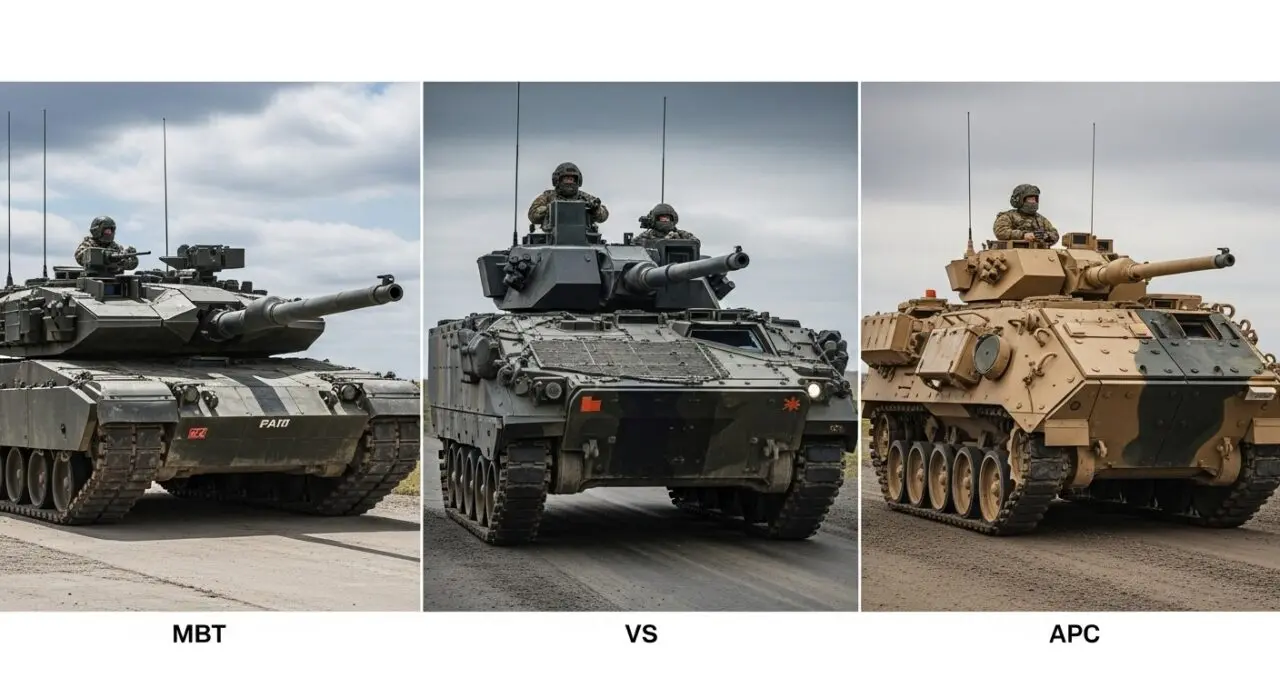
Military organizations around the world use many different ground vehicles, and distinguishing between them can be difficult. Media sources as well as casual observers often describe and categorize military vehicles incorrectly. This can confuse and mislead readers, as the roles of each military vehicle are highly distinct.
By using images and characteristics, one can easily identify and categorize almost all ground vehicles. For each vehicle type, there are two images and a brief account of key facts and characteristics. If you are trying to identify a specific vehicle quickly, skim the guide from top to bottom, finding all the vehicle types whose example image looks something like the vehicle in question. Then read the descriptions of the similar looking vehicles and decide which one matches your vehicle most closely.
A few quick disclaimers:
Note that this guide lists vehicle categories that are modern and somewhat common. This means largely obsolescent groups such as tank destroyers and assault guns are omitted. Also note that some vehicles fit more than one category. For example, the HMMWV (Humvee) is designed to fill the role of a light truck and transport vehicle. However, the addition of armor kits has given some HMMWVs the ability to survive under fire and thus serve as armored personnel carriers. Unfortunately, distinguishing between highly similar vehicles or vehicles subsequently modified to fill another role is beyond the scope of this guide, as it is a difficult task and the methods for identifying modified vehicles vary based on the situation. A later guide may aid in making this distinction.
If you have any questions or difficulties email me at alexhempel2012@gmail.com
Tank
A US M1A1 main battle tank. Note the large tank cannon and prominent turret.
A Russian T-90S main battle tank. Compared to the M1A1, it has a smaller but still substantial turret. Note the features common with all tanks: large treads, large main gun, prominent turret.
Often times the term “tank” is used as a blanket term for any vehicle that has treads or appears militarized. In reality, tanks are designed to fill a highly unique and specific role on the battlefield. Tanks are heavily armed and armored vehicles designed to clear out resilient targets, destroy other vehicles, and use their off-road mobility to exploit weaknesses in the enemy’s defenses. The large size and difficulty of incapacitating tanks makes them formidable psychological weapons.
Size: Large.
Guns: Large 100-125mm main gun, best way to identify a tank. Tank guns are large in diameter, long, and usually protrude beyond the front of the tank. Tanks have many machine guns mounted as well.
Missiles: Some tanks can fire missiles from their main guns, but tanks generally do not carry externally mounted missiles.
Propulsion: Tracked, tracks are large and wide.
Windows: No, except for small sensor or periscope windows.
Notes: Some tanks do not house their main guns in turrets. See exceptions section.
IFV (Infantry Fighting Vehicle)
A Bradley IFV is pictured here; note the much smaller primary cannon than the tanks. Also, to the right of the turret there are two TOW missiles in a launching canister.
The large main cannon (100mm) of the Russian BMP-3 IFV gives it a tank-like appearance. However, the turret is too small for a tank, as are the treads and the chassis.
IFVs are easy to mistake for tanks. The main difference between the two is role and weapon size. IFVs carry infantry into battle as well as participating in combat, whereas tanks do not transport infantry. This difference is reflected by the smaller IFV primary weapon size, which frees up space for infantry and equipment.
Size: Usually somewhat smaller than a tank.
Guns: 20-40mm main gun. Not as large or long as a tank gun but larger than a machine gun. Weapon size the easiest way to distinguish between a tank, an IFV and an APC. IFV guns will usually but not always be mounted in a small turret that does not span the full width of the hull. IFVs only have one primary weapon. If a vehicle has multiple autocannons, it is a SPAAG. IFVs may have multiple smaller machine guns mounted.
Missiles: Some IFVs carry missiles to engage enemy vehicles, since their main guns lack the punch of a tank gun. However, if the vehicle has missiles and multiple guns or multiple barrels (a gatling gun), it is a SPAAG (refer to SPAAG section below).
Propulsion: Tracked or wheeled.
Windows: No.
Notes: Some Soviet IFVs (BMPs) have large guns that are similar in size to a tank gun. In this case, smaller size of the hull and turret is the primary way to differentiate between these IFVs and a tank. The BMP turrets do not extend to the outer edges of the hull, while tank turrets do. See above image.
APC (Armored Personnel Carrier)
Based off the Merkava MBT, the Namer APC is heavily armored. The reason it is classified as an APC is because its primary role is to transport troops, hence the armament of only two machine guns.
This Mexican DN-XI APC is a stark contrast from the Namer APC. Instead of being based off a tank chassis, this APC is based off of a Ford truck platform. Nevertheless, it performs roughly the same primarly role as the Namer: protecting and transporting soldiers.
The primary role of these vehicles is to move troops in and out of areas where they may be subjected to enemy fire. APCs vary widely, from simple up-armored SUVs to tank based vehicles that can withstand immense punishment. The unifying feature of this vehicle class is role role. Because their primary mission is to transport troops, APCs are lightly armed, with at most a grenade launcher or machine gun and sometimes no armament at all.
Size: Varies, from SUV-sized to tank-sized.
Guns: A few machine guns or grenade launchers, or no armament.
Missiles: Some APCs are modified to carry missiles.
Propulsion: Tracked or wheeled.
Windows: Some have none, others have many.
Notes: Many APCs are modified perform specialized tasks, such as serving as a combat ambulance, serving as a mortar platform, etc.
MRAP (Mine Resistant Ambush Protected vehicle)
This British Mastiff MRAP is designed to protect soldiers from IED blasts. Note the truck chassis, a common feature of MRAPs.
This American MaxxPro MRAP is also built from a truck chassis. Note the high center of gravity and truck-like appearance.
Similar in role to an APC, but designed to be particularly survivable against IEDs. MRAPs utilize V-shaped, blast-deflecting hulls to provide underside explosion resistance superior to other APCs. However, this blast-deflecting armor adds substantial weight. As a result, MRAPs are lumbering vehicles with reduced off-road mobility compared to an APC. MRAPs are always wheeled and generally 4X4. The easiest way to distinguish them from wheeled APCs is their bulky, truck-like appearance and high center of gravity.
Size: From large SUV to truck/bus.
Guns: Small machine guns or grenade launchers.
Missiles: No.
Propulsion: Wheeled.
Windows: Yes.
Combat Engineering Vehicle
This fearsome looking American Assault Breacher Vehicle (ABV) is made to clear obstacles and alter the battlefield physically while under fire. The implements at the front indicate that this is a combat engineering vehicle. Built from an Abrams tank chassis, the ABV is extremely durable.
This Israeli D9R Combat Bulldozer is another example of a combat engineering vehicle. It is capable of moving earth and demolishing barriers while under fire.
Combat engineering vehicles are designed to alter in some way the physical characteristics of the battlefield. This may include construction of cover or shelters, mine clearance, trench building, barrier destruction, etc. The difference between these vehicles and simple construction vehicles is that combat engineering vehicles are built to perform these tasks under fire. Thus, they are armored in a way that allows them to withstand at least small arms fire. Some such vehicles are based on tanks and thus are extremely robust. Combat engineering vehicles are generally easy to identify, if one looks for construction-like implements.
Size: Varies greatly based on chassis used and role.
Guns: Some have mounted machine guns.
Missiles: No, except possibly for use in engineering.
Propulsion: Wheeled or tracked, based on chassis used.
Windows: Varies.
Reconnaissance Vehicle
This South African Eland Mk7 armored car is an example of a reconnaissance vehicle. The 4X4 wheeled layout and minimal armor allow this armored car to maneuver rapidly and perform reconnaissance, while the 90mm gun can be used to engage targets of opportunity.
This British-made Scorpion light tank illustrates another common reconnaissance vehicle layout. Light tanks sacrifice armament and armor for small size and mobility. The Scorpion appears somewhat similar to a MBT, however the cannon and small size overall indicate it is a light tank.
Reconnaissance vehicles are highly mobile vehicles designed to move around the battlefield rapidly, gathering information and probing enemy defenses while engaging any ill-protected contacts. When these vehicles encounter other better protected adversaries, their best course of action is to communicate the situation to their command and then retreat as quickly as possible. Chassis layout, level of protection and armament on these vehicles varies widely, and many vehicles can be modified to fit this role. A common purpose-built reconnaissance vehicle layout is a small, lightly armored 4×4 with a relatively large autocannon or machine gun mounted in a turret. Almost all modern light tanks are also built as reconnaissance vehicles. Unfortunately, it is very difficult to tell based on appearance when a vehicle (for example an IFV) has been modified from its original design to a reconnaissance layout.
Size: Large SUV to small tank
Guns: Often mount one low-velocity cannon or machine gun in a small turret.
Missiles: Some are armed with missiles.
Propulsion: Wheeled or tracked.
Windows: Varies.
Technical
This technical consists of a machine gun mounted in the bed of a VW truck; a typical technical layout. Note the crude appearance and usage of consumer-grade vehicle as a weapon platform.
This technical is built from a pickup truck chassis and mounts a large anti-aircraft gun. It also features improvised armor and camouflage.
A technical is an improvised fighting vehicle produced by mounting a weapon on a vehicle not intended for combat. Technical are easy to spot as a result of their lack of protection and refinement, as well as the fact they are based on consumer grade vehicles. A typical technical consists of a 4X4 pickup truck with a machine gun or anti-aircraft gun mounted in the bed. While technicals have abysmal survivability, they are cheap to produce and the relatively heavy armament they carry is sufficient against infantry and other ill-protected vehicles. Technicals are also faster and more mobile than their armored military-grade counterparts, allowing them to strike quickly and escape. Technicals are a common sight in Africa and the Middle East, where combatants either cannot afford to or are not allowed to purchase purpose-built armored vehicles.
Size: Small to large truck of SUV.
Guns: Generally one rear-mounted gun, usually with no turret or protection of any kind for its operator.
Missiles: Some technicals have small missile tubes instead of a gun.
Propulsion: Wheeled.
Windows: Yes.
SPAAG (Self-Propelled Anti-Aircraft Gun)
This Russian Tunguska SPAAG is armed with autocannons and anti-air missiles. Clearly visible on each side of the turret are the missile tubes. The circular object on the front of the turret is a radar antennae.
Pictured here is a Japanese Type 87 SPAAG. Like the Tunguska, it has dual autocannons. However, it is not armed with missiles.
Generally lightly armored and built from IFV or APC chassis. Armed with anti-aircraft guns and sometimes missiles. Despite being built for anti-aircraft combat, the powerful autocannons of a SPAAG are suited to ground combat as well. SPAAGs have radar sets with which to obtain firing solutions on aircraft. Often times, the radar antennae will be mounted externally and thus visible.
Size: Generally smaller than a tank; tracked APC or IFV sized.
Guns: Either multiple autocannons (20-40mm in diameter) or a rotary cannon (gatling gun). May also have machine guns mounted.
Missiles: Some carry short range anti-air missiles; these will generally be small and turret mounted.
Propulsion: Tracked.
Windows: No.
Exceptions: A vehicle that carries anti-air missiles but does not have autocannons is not a SPAAG, hence “gun” in the acronym.
SPG (Self-Propelled Gun)
This Russian made Msta-S SPG may look tank-like at first, but upon closer inspection the abnormally tall turret reveals that it is not a tank. The gun securing clamp and muzzle brake also indicate that this is a SPG.
The American Paladin SPAAG has a large 155mm howitzer with a prominent muzzle brake. The large turret and gun fastening clamp are SPG features.
An SPG is essentially a large howitzer mounted on an armored chassis with treads for mobility. This arrangement makes the SPG able to maneuver quickly compared to towed artillery, which needs to be set up prior to firing and packed up prior to moving. While a SPG looks similar to a tank, there are some distinctions which allow one to distinguish between the two. First, the weapon of an SPG is often much larger than the weapon of a tank. Unlike tanks, an SPG howitzer will often have a large muzzle brake. SPGs also have a system to protect and fasten their weapons in place during movement. Second, the turret of an SPG is much taller relative to the rest of the chassis than the turret of a tank. While the SPGs may appear to have tank-like armor, their armor is actually quite thin.
Size: Large.
Guns: Large howitzer, small machine guns for self defense.
Missiles: No.
Propulsion: Tracked.
Windows: No.
Rocket Artillery TEL (Transporter-Erector-Launcher)
This Polish Langusta rocket artillery TEL is a modernized version of the Soviet Grad rocket artillery system. Note the multitude of rocket launch tubes.
This TEL carries the Topol ICBM. Armed with a fusion warhead, the Topol system is designed to be survivable by virtue of its mobility.
A Transported-Erector-Launcher (TEL) is a vehicle designed to transport and launch missiles. A rocket artillery TEL is a missile carrying vehicle (usually based on a medium or heavy truck) designed to strike surface targets. Rocket artillery is generally identifiable by the fact it utilizes either multiple smaller launch tubes to bombard an area or one very large missile for long range attacks, as opposed to surface-to-air missile systems, which generally have a handful of large and complex rockets. However, it is sometimes very difficult to distinguish between the two based on visual characteristics alone.
Size: From small to very large.
Guns: No, except possibly some small arms for self defense.
Missiles: Yes. Can range from a multitude of small missiles to a singular nuclear-capable ballistic missiles.
Propulsion: Wheeled or tracked.
Windows: Yes.
Surface-to-Air Missile System TEL (Transporter-Erector-Launcher)
This Russian S-300VM system is designed to intercept missiles, including ballistic missiles. Clearly visible are the elevated missile tubes in the rear of the vehicle.
This Dutch-operated American-built Patriot PAC-3 battery’s TEL is mounted on a trailer.
Surface-to-air missile (SAM) TELs are vehicles which carry and launch surface-to-air missiles. Often times they are built from the chassis of a heavy truck. SAM TELs generally have a number of large tubes in which the missiles are housed. It can be difficult to distinguish between a SAM TEL and a rocket artillery TEL. The surest way to differentiate between the two is the fact that a SAM TEL will generally have a radar platform nearby or will itself mount a radar antennae.
Size: Varies greatly.
Guns: No, except possibly some small arms for self defense.
Missiles: Yes. Fires guided surface-to-air missiles.
Propulsion: Wheeled or tracked.
Windows: Yes.
Light Truck/Utility Vehicle
Based on the American HMMWV, this Japanese Koukidsousha is a typical light truck. Note the aesthetic similarity to a full size SUV. This vehicle is not an APC because it is not armored.
A British Land Rover. This militarized land rover is another prime example of a light utility vehicle, which is essentially a military SUV.
Light trucks perform a multitude of roles on the battlefield. They are unarmored, all-terrain vehicles that are similar to a large SUV or pickup. Light trucks can carry troops, tow trailers, haul provisions, and traverse difficult terrain. Many are modified to perform a specific role. For example, a HMMWV may be modified with armor, turning it into an APC, or it may have communications equipment added, allowing it to function as a command center. Light trucks are some of the smallest vehicles in regular military use.
Size: Similar to a large pickup or SUV.
Guns: Some have weapons mounted, especially when modified or performing troop transport.
Missiles: Not usually, unless modified.
Propulsion: Wheeled.
Windows: Yes.
Medium/Heavy Truck
A Russian-made Kamaz 5350 medium truck. Note the cosmetic similarities to a civilian medium truck. Military trucks generally have superior off-road mobility to civilian trucks, hence the knobby mud tires.
This German MAN SV truck is built to carry battlefield logistics and supplies.
Medium and heavy trucks are the bulk movers of the ground forces. Military operations consume vast amounts of fuel, ammunition, and food. Trucks offer a much cheaper alternative to airlifting supplies, and can reach remote areas where landing a plane or rotorcraft is not feasible. Military trucks usually have off-road capabilities superior to their civilian counterparts because roads near a conflict zone are often shoddy or destroyed. Like light trucks, many heavy trucks are modified into command centers, communications equipment platforms, etc.
Size: Similar to a civilian medium or heavy truck. Can be non-articulated or tractor-trailer.
Guns: Not usually, unless modified into a technical.
Missiles: Not usually, unless modified into a missile TEL.
Propulsion: Wheeled.
Windows: Yes.
Exceptions:
Some vehicles are so unusual as to not match any of the aforementioned descriptions. This section will attempt to cover some of the most commonly seen vehicles that don’t resemble any of the descriptions above. This section is a work-in-progress.
Stridsvagn 103
This Swedish tank lacks a staple tank feature: the turret. In order to decrease cost and lower the profile of the tank, an ingenious suspension system was devised that aimed the gun by pointing the vehicle at the target. Of course, this eliminates the ability of the tank to fire at targets that are not directly in front of it. This vehicle is no longer in active duty, and the principle has not been used subsequently.
Stryker MGS
This vehicle consists of a large 105mm autoloaded cannon mounted on the chassis of a Stryker APC. It was conceived of as a way to offer tank-like firepower on a platform that could easily be moved around and airlifted. Despite its appearance, the vehicle is not designed to fight against tanks or other well protected vehicles, as it lacks the necessary protection. Generally described as an “assault gun.”
TOS
This fearsome looking Russian vehicle is built from the chassis of a T-72 and mounts a battery of thermobaric missiles. This setup makes it unique in being a rocket system able to withstand significant punishment. Most rocket systems are designed to operate safely behind the front lines. The thermobaric warheads mounted on each missile are uniquely devastating, as they consume vast amounts of oxygen to produce a large explosion. Other nations also use such warheads, although not in this configuration. These rocket launchers have been spotted in conflict zones where Russia is a player; some have been sold other nations.

Heavy Hauling Services: Navigating the Complexities of Oversized and Industrial Freight

The Importance of Data in Modern Sports Analysis

Homeowners: Key Questions to Ask Before Hiring a Plumber

هنتاوي.com: The Ultimate Platform for Success

Tank vs. IFV vs. APC: A Military Ground Vehicle Identification Guide
