
Tech
Beyond the Per-Piece Price: How Understanding CNC Machining Cost Per Hour Cuts Your Total Equipment Ownership Cost by 20%

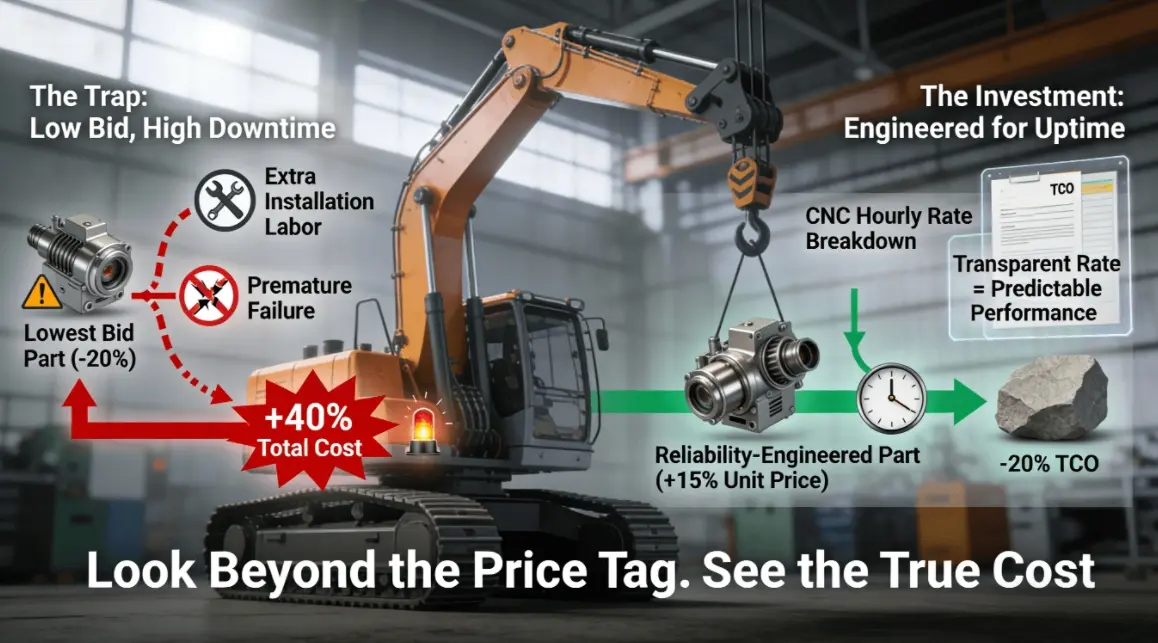
Fleet managers procuring critical custom parts — custom brackets, gearbox housings, or sensor enclosures — often fall into the “lowest bid” trap. Selecting the CNC supplier with the cheapest quote frequently leads to parts failing prematurely, triggering unplanned downtime. The cost of a single downtime event, encompassing repair hours, delay penalties, and asset idleness, can reach thousands of dollars, ultimately causing the total cost of equipment ownership to skyrocket. The root cause is a procurement decision that focuses solely on the “per-piece price,” while ignoring the deep cost drivers that determine part reliability and longevity: the precision, consistency, and quality systems of the manufacturing process itself. These factors are directly encoded in a supplier’s CNC machining cost per hour structure, but traditional price comparison models fail to capture this critical information.
This article provides a “Total Cost of Ownership (TCO)-Based CNC Part Procurement Framework” tailored for fleet and equipment management. It guides you in deconstructing a CNC quote, understanding the “quality and reliability premium” behind the hourly cost, and quantifying its link to equipment downtime risk. This transforms procurement from a reactive “price shopping” exercise into a proactive “risk mitigation and value investment” decision. To make this shift, we must first re-examine the true composition of “cost” and trace its journey from the machine shop floor to your fleet’s bottom line.
Why Does the “Lowest Bid” for a Replacement Part Often Lead to the Highest Fleet Downtime Cost?
This section illustrates, through a comparative case study, how a low upfront price can result in exponentially higher total costs due to failures, unplanned downtime, and associated operational penalties.
1. The Real Cost of a “Bargain” Part: A Hydraulic Bracket Case Study
Consider a custom bracket for a crane’s hydraulic system. Supplier Awins the bid with a price 20% lower than competitors. The part arrives, but poor tolerance control makes installation difficult, requiring extra labor. Worse, under operational vibration, a subtle stress concentration from inconsistent machining leads to a fatigue crack after six months, causing a two-day crane shutdown. Supplier B’spart, though 15% more expensive upfront, fits perfectly and lasts the expected service interval. When factoring in the downtime cost — lost revenue, expedited shipping, and repair labor — the total costof Supplier A’s “cheap” part is 40% higher. This underscores that the true metric is Total Cost of Ownership, not unit price.
2. Quantifying the Intangible: The Staggering Expense of Unplanned Downtime
The financial impact of downtime is often underestimated. It includes direct costs like emergency repair labor and parts, but the larger costs are indirect: lost asset utilization, contract penalties for delayed projects, and the managerial time spent on crisis resolution. For a single piece of heavy equipment, downtime can cost thousands per day. A procurement strategy that selects parts based on the lowest unit price without considering failure probability is effectively gambling with these substantial, variable costs, a principle highlighted in supply chain cost frameworks like the APICS SCOR model.
3. Adopting a TCO Mindset for Fleet Operations
Therefore, savvy procurement shifts from asking “What is the price per piece?” to “What is the cost per reliable operational hour this part will deliver?” This requires building a simple TCO model that adds the estimated cost of potential failures to the purchase price. To master how to systematically break down and evaluate these cost drivers, this in-depth guide on CNC machining cost per hour provides a complete theoretical and practical analysis.
What’s Included in a “CNC Machining Hourly Rate”? It’s More Than Just Electricity.
This section deconstructs the components of a machining hourly rate, arguing that each line item is an investment in predictability, precision, and risk reduction, directly impacting the long-term reliability of the parts produced.
1. Machine Investment and Precision Sustainment
The hourly rate must recover the capital cost of the machine. A modern, high-precision 5-axis machining center costs significantly more than a basic 3-axis mill. More importantly, the rate funds the rigorous preventive maintenance and calibration required to keep that machine operating within micron-level tolerances year after year. Paying a higher rate for a shop with newer, well-maintained equipment is an investment in the geometric consistency and dimensional accuracy of your parts, which translates directly to reliability in the field.
2. The Value of Skilled Labor and Engineering Oversight
A significant portion of the rate covers skilled labor. This isn’t just the machine operator; it includes the CAM programmer who optimizes toolpaths for strength and efficiency, and the quality engineer who designs inspection protocols. Experienced personnel can identify potential manufacturability issues in the design phase and execute processes that prevent errors, acting as a proactive quality filter. This expertise, paid for in the hourly rate, prevents costly mistakes that lead to field failures.
3. Overhead for Systems that Prevent Failure
Finally, the rate includes overhead for the quality management system itself. Certifications like ISO 9001 and IATF 16949 are not free; they require documented procedures, internal audits, and continuous training. This “system cost” is the premium you pay for a supplier whose entire operation is designed to prevent defects through standardized, controlled processes, rather than inspecting them out after the fact. This systemic approach is what delivers long-term part reliability.
From “Cost per Piece” to “Cost per Operational Hour”: A New Analysis Framework
This section introduces a practical, actionable TCO calculation model that fleet managers can use to evaluate quotes, factoring in both the purchase price and the probabilistic cost of part failure.
Building the TCO Calculation Model: The model is straightforward: Part TCO = Purchase Price + (Probability of Failure × Cost of a Single Failure). The purchase price is the quote. The Probability of Failure is lower for parts from suppliers with robust processes (evidenced by certifications, inspection reports, and technology). The Cost of a Single Failure must be estimated and includes: the replacement part cost (again), the labor to install it, the cost of the downtime event, and any ancillary penalties.
Applying the Model for Informed Decision-Making: Using this model, two quotes can be compared on a like-for-like basis. Supplier X has a lower unit price but a higher estimated failure probability due to less sophisticated equipment. Supplier Y has a higher price but a much lower failure probability. When the high cost of downtime is factored in, Supplier Y’s TCO will often be lower. This analytical approach turns procurement into a data-driven risk management exercise directly contributing to asset utilization improvement.
From Analysis to Actionable Partnership: This framework empowers you to have substantive discussions with suppliers about reliability, not just cost. Therefore, translating the TCO model into actual, predictable operational outcomes hinges on partnering with a custom CNC precision machining provider capable of engineering collaboration and stable delivery, turning theoretical cost savings into realized operational efficiency.
3-Axis vs. 5-Axis: How Does Machine Choice Affect Both Part Cost and Long-Term Reliability?
This section analyzes the impact of machining technology selection on both the initial quote and the long-term service life of a part, arguing that the optimal choice for TCO is not always the technology with the lowest hourly rate.
1. The Hidden Cost of Multiple Setups in 3-Axis Machining
A complex sensor mount may be quoted for 3-axis machining. This requires multiple setups — flipping and re-fixturing the part. Each setup introduces a potential for datum shift and cumulative error, which can compromise features like sealing surfaces or bolt hole alignment. A part that doesn’t fit perfectly on installation may work initially but is more susceptible to vibration loosening or seal failure over time, leading to premature maintenance.
2. The Reliability Dividend of Single-Setup 5-Axis Machining
The same part on a 5-axis machine can be completed in one setup. All features are machined in relation to a single, unchanging datum, ensuring exceptional geometric integrity and positional accuracy. While the hourly ratefor a 5-axis machine is higher, the total job time is often shorter due to eliminated setups, and the resulting part is inherently more reliable. The perfect flatness of a sealing surface or the true position of mounting holes achieved in one setup prevents leaks and misalignment, extending service intervals.
3. Making the Techno-Economic Decision
The choice isn’t automatic. The decision should weigh the part’s complexity, criticality, and the cost of potential failure. For a non-critical bracket, 3-axis may offer the best TCO. For a mission-critical pump housing, the superior accuracy and reliability of 5-axis machining, despite a higher rate, will protect against far more expensive downtime, an investment logic supported by analysis of advanced manufacturing technology ROI.
The Supplier Audit for Procurement Managers: 4 Questions on Cost and Reliability
This final section provides a practical audit checklist for procurement managers, shifting the supplier evaluation from price negotiation to an assessment of processes and systems that guarantee part quality and reliability.
Demand Evidence of Process Capability: Move beyond claims. Ask: “Can you provide the full first-article inspection report (CMM data) for a recent part of similar complexity to ours?” A supplier confident in their process will share this data. The report demonstrates their ability to hit and document tight tolerances consistently, which is a direct indicator of the process control that prevents field failures.
Probe Their Commitment to Long-Term Precision: Investigate their investment in stability. Ask: “What is your preventive maintenance and calibration schedule for your critical machining centers, and how do you document it?” A shop that meticulously maintains its equipment ensures the part you get today is identical to one you order in two years, which is essential for fleet parts management and inventory predictability.
Understand Their Commercial and Quality Philosophy: Ask questions that reveal their business and quality mindset: “What is your process if a part fails prematurely in the field under normal use?” and “Can you provide tiered pricing based on our annual volume to optimize our long-term procurement strategy?” The first question tests their warranty and corrective action process; the second shows if they think in terms of partnership. A supplier aligned with standards like IATF 16949 operates on a “prevention over correction” philosophy, systematically reducing failure probability, which aligns perfectly with fleet management’s preventative maintenance goals.
Conclusion
In logistics and fleet management, where operations depend on continuous equipment uptime, the procurement of critical spare parts must evolve from a short-term “price savings” model to a long-term “value and risk investment” model. By adopting a Total Cost of Ownership analysis framework, managers can look beyond the per-piece price to assess the fundamental impact of manufacturing quality on equipment reliability. This enables them to transform the supply chain from a passive cost center into a core competitive advantage that safeguards operational resilience and maximizes asset utilization.
FAQs
Q: What is a realistic hourly rate range for CNC machining, and why does it vary so much?
A: Hourly rates for CNC machining typically range from $50 to $200+. The variation stems from machine capability (3-axis vs. 5-axis), geographical location (affecting labor and overhead), and the shop’s investment in quality systems and engineering support. A higher rate often reflects the investment in precision and consistency that reduces your long-term operational risk.
Q: How can we reduce CNC machining costs without sacrificing quality for our fleet parts?
A: Focus on design optimization for manufacturability. Simplifying geometries, standardizing features, and specifying realistic tolerances on non-critical areas can significantly reduce programming and machining time. The most effective method is early collaboration with a supplier for a Design for Manufacturability (DFM) analysis.
Q: When is it worth paying the premium for 5-axis machining over 3-axis?
A: Choose 5-axis when the part has complex contours or multiple angled features requiring multiple 3-axis setups. The premium is justified by superior accuracy, reduced setup time, and often a more reliable part due to better geometric integrity from single-setup machining, which lowers long-term failure risk.
Q: What information do I need to provide to get a meaningful quote that supports TCO analysis?
A: Beyond the 3D CAD file, provide the part’s function, expected annual usage, operating environment (vibration, chemicals), and any known failure modes from previous versions. This context allows the supplier to recommend the most cost-effective material and process for long-term reliability.
Q: What are common hidden costs in CNC machining quotes that affect TCO?
A: Scrutinize clarity on: First-article inspection costs, special tooling or fixture charges, and material certification scope. Unclear charges here can indicate a lack of process transparency. A reputable supplier will itemize these, enabling accurate TCO comparison and budgeting.
Author Bio
This article is based on extensive experience in precision manufacturing, collaborating deeply with global industrial equipment manufacturers and operators. As a certified manufacturing partner (ISO 9001, IATF 16949, AS9100D), the team at LS Manufacturing not only provides precision parts but is dedicated to helping clients optimize the total lifecycle cost of critical components. Upload your equipment part drawings and operating conditions today to receive a complimentary TCO-Based Part Procurement & Potential Risk Analysis Report.


Pulsatile Endocrine Signaling and Pituitary Secretagogue Dynamics in Preclinical Investigation
Heavy Hauling Services: Navigating the Complexities of Oversized and Industrial Freight

The Importance of Data in Modern Sports Analysis

Tank vs. IFV vs. APC: A Military Ground Vehicle Identification Guide

هنتاوي.com: The Ultimate Platform for Success
